A mandated leave of absence is rarely out-of-the-blue and is often a decision culminating from weeks or months of worsening circumstances. Early on in this process, Student Affairs may have already mandated certain actions from you in order to stay enrolled.
Being on a Student Affairs Mandate
A mandate generally occurs after some sort of initial crisis has occurred, one that by itself isn’t bad enough to immediately warrant a leave, but that could if you don’t follow the instructions you’re given. You will likely find out you’re under mandate in one of two ways:
E-mail: Your Student Affairs point person will e-mail you a letter outlining the exact requirements in the mandate (more on who this is and what the letter looks like below)
In-person meeting: This point person can also explain the mandate to you in a synchronous meeting, as well as clarify why it was enforced in the first place.
What does Student Affairs need from me?
It depends entirely on the crisis and how it’s impacting you right now. In my scenario, I was involuntarily admitted to UPMC Western Psych just over a week before starting my sophomore year, prompting Student Affairs to schedule a meeting and enforce a mandate. See Figures 2 and 3 for the document sent to me and what your requirements could look like:
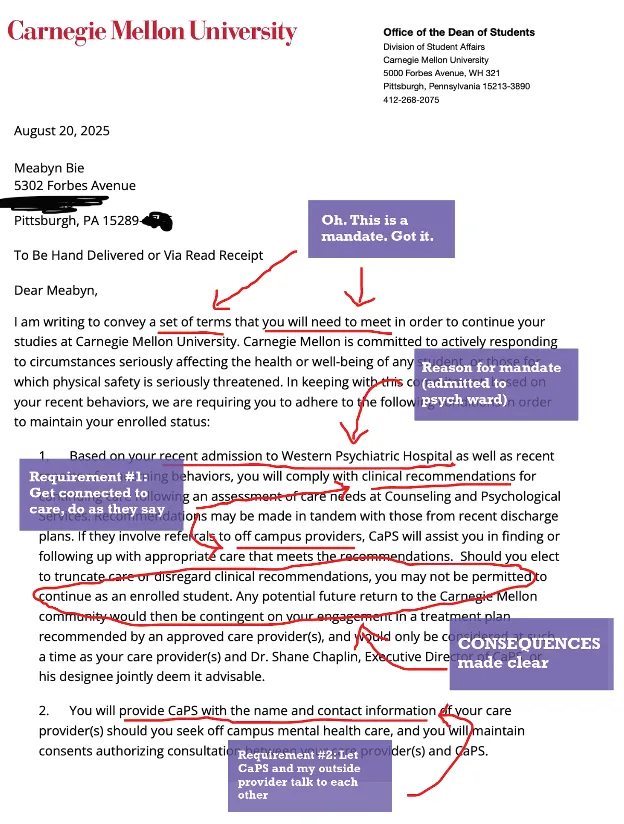 Figure 2: Page 1, with annotations
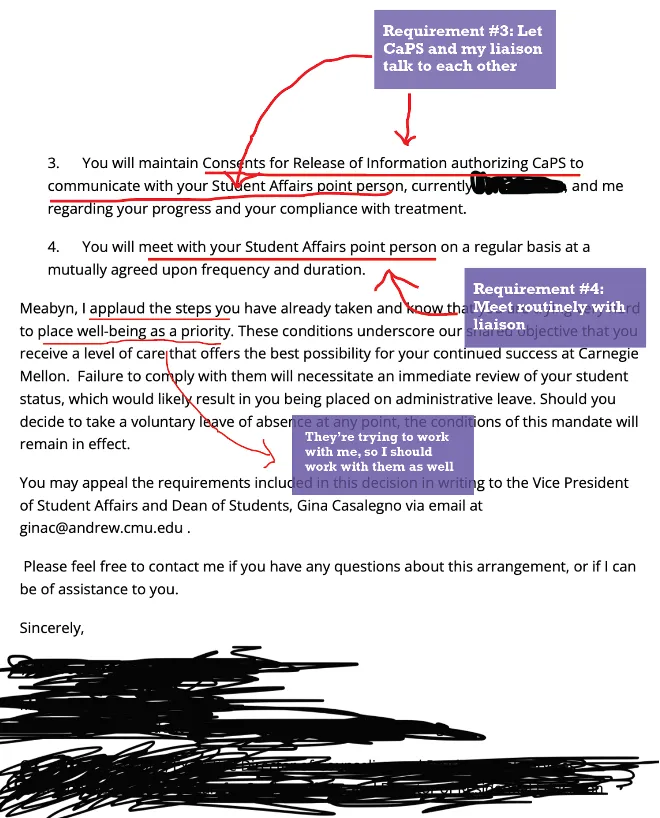 Figure 3: Page 2, with annotations
Note 1: I mention updating and communicating with a liaison. This person is a core member of your Student Affairs mandate team, and I will cover this shortly.
Note 2: The bottom of Figure 3 informs you that you can appeal your mandate, and you will see later that the same appeal offer existed in the next version of my mandate when I went on leave. However, Student Affairs wants to see that you have a stronger support system and are more stable, so do not expect to appeal immediately and win (Anonymous).
Your Treatment Team
During your time under mandate, you will also be connected to people in multiple departments (Anonymous). Below is a non-exhaustive list of who they might be:
Academic advisor(s)
This will either be your first-year advisor or the advisor(s) designated to your major(s) or department(s), depending on your college’s major declaration timeline and your current class standing. You can look up who they are on SIO by going to Academic Info -> Enrollment Status Figure 4. Then scroll down to Advisor Info to see the names of all your academic advisors.
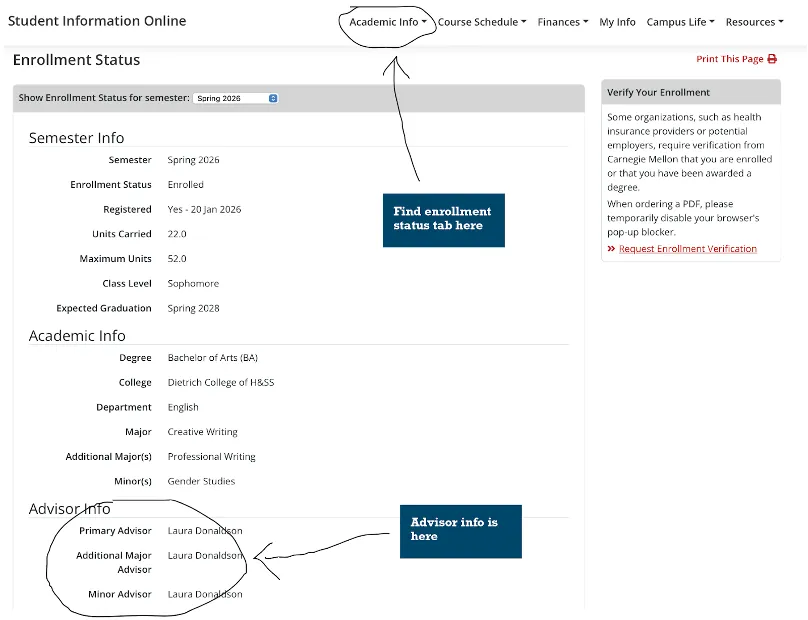 Figure 4: How to navigate SIO’s interface to find your advisor(s)’ names. Their contact info can also be found in the CMU directory
Please reach out to your advisor(s) if you do not have accommodations and must seek extensions due to outside circumstances, as a letter from your advisor carries a lot of weight. Some advisors will also have a link in their e-mail signature that lets you schedule an appointment with them (see Figure 5).
 Figure 5: Meeting scheduling mechanism from the e-mail signature of English advisor Laura Donaldson
If not, feel free to use the following e-mail template and to tweak it as you see fit:
Hello (advisor’s name),
I hope you are well. I am writing to let you know of some outside circumstances that are affecting my ability to attend classes and turn in work on time.
Could we possibly schedule a meeting to discuss requesting extensions and acquiring disability accommodations? Thank you so much!
Sincerely,
(your name)
Liaison
This is your go-to person for any questions surrounding your ability to stay enrolled while on-campus, and your primary person of contact should you go on leave. If you live on campus, your liaison will likely be your housefellow; otherwise, you will be assigned to someone in Student Affairs.
It’s possible to be assigned a liaison well before being put on mandate, which would generally happen if you’ve either reached out to CMU for help or someone has reached out on your behalf. For me, I was connected to my liaison in Student Affairs in July 2025 after a friend submitted a Cares Form for me (more on that later), and communication between us increased after my psych ward admission a month later.
Student Affairs point person
Ignore the wording in Figure 3. Your point person is not your liaison, but rather someone directly involved in decisions revolving enforcing mandates and LOAs. They are the person who e-mails you your mandate document, and in the case of an emergency that calls for a breach of FERPA (more on that later), they will contact your parent(s)/guardian(s).
Professors
Though they’re not directly involved in your mandate process and may not even know about your situation, you should still communicate with them if you need academic flexibility. If you have accommodations (permanent or provisional), Disability Resources would have notified them, but in case they didn’t see it, let them know anyway as early as possible.
That way, you can reference your accommodations at any point you need an extension. Do not be ashamed to use them, as any reasonable professor will know to respect them.
Office of Disability Resources (ODR)
To get connected to ODR, you will first need to fill out a disability application form and schedule an appointment with an ODR point person via their web page for student accommodations.
At your meeting, your ODR point person can put provisional accommodations in place, which apply to all of your classes for one semester. Afterwards, you will need to secure a doctor’s note from your healthcare provider for permanent accommodations. Please contact said provider to set this process in motion.
Counseling and Psychological Services (CaPS)
While they won’t take you in for therapy or psychiatry while you are seeking off-campus treatment, CaPS will still assign you a case manager, whose role is to communicate with your off-campus treatment team about your progress. If any complications arise (such as difficulty getting connected to therapy or accessing accommodations), please meet with your case manager to sort out the issue. If you’re unsure who your case manager is, ask your liaison.
Resources While on Mandate
Student Academic Success Center (SASC)
Their website can be found here, and their services are open to all students. SASC offers feedback for writing assignments, tutoring for specific classes, mentorship to build better academic habits, and more!
Cares Forms
If you’re concerned about someone else, or if you’re reading this document to know how to support a friend on a mandate, a Cares Form can be submitted here to connect them to more resources if you feel like they’d benefit from that.
CaPS Hotline
If you need to speak with someone, you can call CaPS 24/7 at 412-268-2922 to reach a counselor. Note that they are mandated reporters and will dispatch CMU PD if you are in danger of hurting yourself or someone else.
Note: Because CMU provides too many support resources for me to individually name them all, I’ve instead linked this page that has a full list of resources you can seek should you need them.